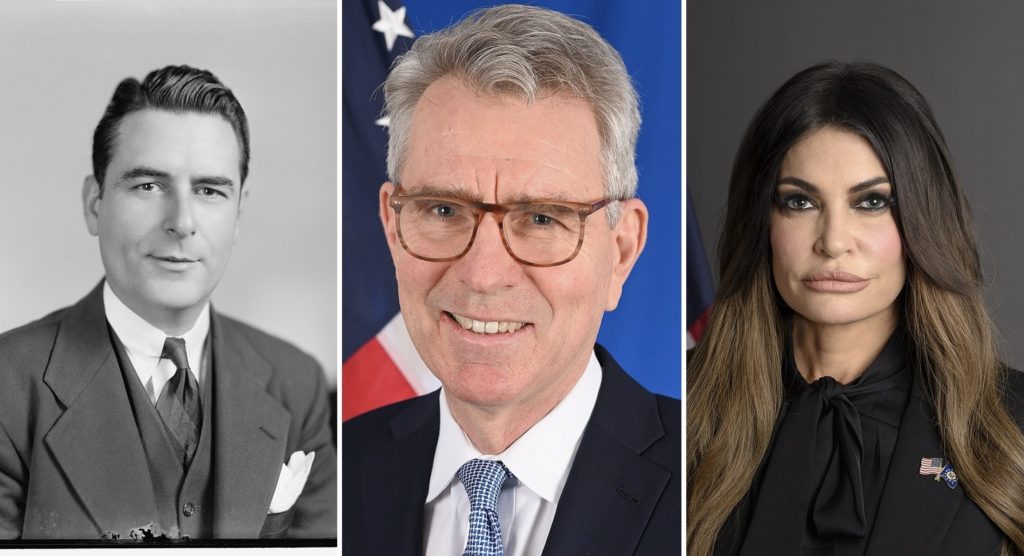
The departure of Kimberly Guilfoyle from the U.S. Embassy in Athens in October brought an abrupt end to one of the most talked-about American diplomatic appointments in Greece in recent years.
A former television personality and close ally of President Donald Trump, Guilfoyle had been ambassador for less than a year when she was asked to resign amid allegations of misconduct, which she denies.
Her departure has revived a familiar debate over whether American presidents should appoint experienced diplomats or political allies to important overseas posts.
In Greece, however, the argument goes well beyond Guilfoyle.
For nearly eight decades, American ambassadors have occupied a special place in the country’s political life. Some became deeply involved in Greek affairs. Others found themselves dealing with military coups, tensions with Turkey, terrorism, and a public that was often deeply suspicious of Washington.
The relationship has changed almost beyond recognition since the early Cold War years, when an American ambassador could exert extraordinary influence over Greek politics.
Yet the history of the U.S. Embassy in Athens is also, in many ways, the history of Greece’s complicated relationship with America.

U.S. Ambassador to Greece Henry Tasca and his wife Natalina. Photo: Public domain
When the Ambassador Was More than a Diplomat
In the years immediately after World War II, Greece was struggling to recover from occupation and civil war.
Britain, which had traditionally played a leading role in Greek affairs, could no longer afford to support the country. The United States stepped in, determined to prevent Greece from falling under communist influence.
President Harry Truman’s announcement in 1947 of American assistance to Greece and Turkey marked the beginning of a new era.
Washington provided money, military equipment, and advisers. With that assistance came considerable political influence.
Henry Grady, who served as ambassador from 1948 to 1950, was closely involved in overseeing the American aid program.
But it was his successor, John Peurifoy, who became a household name in Greece – and not always for the right reasons.
Peurifoy arrived in Athens in 1950, shortly after the end of the civil war. A determined anti-communist, he took a direct interest in the country’s political future.
He supported Field Marshal Alexandros Papagos, whose Greek Rally party won the 1952 election, and made little effort to hide Washington’s preference for a strong government firmly aligned with the West.
To many Greeks, Peurifoy represented an America that believed it had the right to decide who should govern Greece.
His name became synonymous with foreign interference, a reputation that has survived long after his death.
Yet the Americans saw matters differently. Greece had survived the communist insurgency and joined NATO in 1952. From Washington’s perspective, its investment had helped secure an important ally.
It was a relationship built on common strategic interests, but hardly one between equals.
The Junta Years and Cyprus
The military dictatorship of 1967-1974 brought another difficult chapter.
Phillips Talbot was ambassador when a group of army officers seized power on April 21, 1967, ending parliamentary democracy.
Talbot was uneasy about the coup and the colonels who carried it out. But the United States, concerned about Greece’s strategic importance during the Cold War, continued to deal with the regime.
For many Greeks, that was evidence enough that Washington was prepared to tolerate a dictatorship as long as Greece remained firmly in the Western camp.
Henry Tasca, who replaced Talbot in 1970, faced an even more serious crisis.
In July 1974, the Greek junta backed a coup against Cyprus’ president, Archbishop Makarios. Turkey invaded the island five days later.
The invasion brought the dictatorship in Athens to an end and left Cyprus divided.
Washington’s response, shaped largely by Secretary of State Henry Kissinger, caused deep resentment in Greece and among Greek-Americans.
Tasca was the most visible representative of American policy in Athens, although he did not make the crucial decisions.
For years afterward, American ambassadors had to contend with the belief that the United States had failed Greece and Cyprus at a moment of national tragedy.
The Cyprus issue also helped mobilize Greek-Americans politically. Community organizations and members of Congress campaigned for an American arms embargo on Turkey, which Congress imposed in 1975.
It was an early demonstration of how the Greek-American community could influence Washington’s policies, even when those policies were opposed by the executive branch.

Nicholas Burns, ormer U.S. Ambassador to Greece. Photo: Public domain
A Different Kind of Relationship
After democracy returned to Greece, the American ambassador’s job gradually changed.
Greek governments became more willing to challenge Washington, particularly after Andreas Papandreou came to power in 1981.
Papandreou openly criticized American foreign policy and demanded changes to the arrangements governing U.S. military bases in Greece.
The ambassador could no longer expect Athens to follow Washington’s wishes simply because the United States was Greece’s most powerful ally.
In 1989, Michael Sotirhos became the first Greek-American ambassador to Greece.
Born in New York to Greek immigrant parents, Sotirhos brought a personal connection to the country that few of his predecessors possessed.
His appointment was welcomed by Greek-Americans, who saw it as recognition of the community’s growing political influence.
But it also illustrated a dilemma that would confront other Greek-American diplomats: representing the United States in a country they regarded as part of their own heritage.
Knowing Greece and understanding its people could be an advantage. It did not mean that American and Greek interests would always coincide.
The Imia Crisis and the Kosovo War
The 1990s brought new challenges.
Thomas Niles was ambassador during the Imia crisis in January 1996, when Greece and Turkey came close to war over two small islets in the Aegean.
American diplomatic intervention helped defuse the confrontation, although the crisis left bitter feelings in Greece, particularly over Washington’s refusal to take a clear position on sovereignty.
Nicholas Burns, who arrived in 1997, faced a different set of problems.
The NATO bombing of Yugoslavia in 1999 provoked widespread opposition in Greece, where public sympathy for Serbia was strong.
Burns also had to deal with the threat posed by the November 17th terrorist organization, which had murdered American diplomats and officials.
His tenure coincided with a period when Greek-American relations were improving at the government level, even though anti-American sentiment remained widespread among the public.
Burns was a frequent presence in the Greek media and sought to explain Washington’s policies directly to audiences that did not necessarily agree with him.
It was a different approach from the days when American ambassadors could intervene openly in Greek political affairs.

U.S. Ambassador to Greece Geoffrey Pyatt. Photo: Eurokinissi/Giorgos Kontarinis
The Years of Geoffrey Pyatt
When Geoffrey Pyatt arrived in Athens in 2016, Greece was still dealing with the consequences of its economic crisis.
Pyatt, a career diplomat who had previously served in Ukraine, quickly became one of the most visible American ambassadors in recent years.
He traveled extensively, met business leaders and local officials, and promoted Greece as a destination for American investment.
Defense cooperation expanded significantly during his six years in Athens.
The United States increased its use of Greek military facilities, including Alexandroupolis, which became particularly important as tensions with Russia intensified.
Energy was another priority. Pyatt strongly supported projects intended to reduce Southeastern Europe’s dependence on Russian supplies.
He also backed the Prespa Agreement, which ended the long dispute between Greece and North Macedonia over the latter’s name.
Pyatt’s energetic public diplomacy occasionally attracted criticism, but his years in Athens coincided with a substantial strengthening of bilateral relations.
The contrast with the Cold War era was striking. Washington no longer needed to pressure Greece into remaining in the Western alliance. The two governments increasingly found themselves pursuing similar strategic goals.
Greek-American Ambassadors and Political Connections
Pyatt’s successor, George Tsunis, was a different kind of ambassador.
A New York businessman and political supporter of President Joe Biden, Tsunis had strong family roots in Greece. His parents came from Platanos, a village in Nafpaktia, and he spoke frequently about his Greek upbringing and the values his family brought to America.
Like Michael Sotirhos before him, Tsunis was warmly received by the Greek-American community.
During his tenure, he emphasized investment, tourism, education, and the increasingly close ties between the two countries.
His appointment also reflected a longstanding American practice: presidents regularly select political supporters and donors for diplomatic positions.
Supporters of the system argue that such ambassadors may have something career diplomats sometimes lack – direct access to the president.
That argument became particularly prominent when Trump nominated Kimberly Guilfoyle in December 2024.
Guilfoyle had no previous diplomatic experience, but her connections to Trump’s political circle were well established.
Some commentators questioned whether she was suited to the post. Others argued that her access to the White House might prove valuable, especially when Greece needed Washington’s support on issues involving Turkey, Cyprus, and regional security.
Patrick Theros, the veteran Greek-American diplomat and former U.S. Ambassador to Qatar, made an interesting observation before Guilfoyle arrived.
Speaking to Parapolitika, he suggested that her effectiveness would depend largely on her personal relationship with the White House.
He also raised the possibility of competing influence between the American ambassadors in Athens and Ankara, particularly when the two countries disagreed over regional issues.
It was a reminder that ambassadors do not always have equal access to those making decisions in Washington.
Guilfoyle’s tenure ended abruptly in October, 2026 amid allegations that she had sought financial favors in connection with access to senior administration officials. She has denied wrongdoing.
Her departure brought renewed scrutiny of political appointments, although such appointments have been a feature of American diplomacy under both Republican and Democratic presidents.

Ambassador of the U.S. to Greece George J. Tsunis gave the closing remarks at the 26th Annual Capital Link Invest in Greece Forum in New York on December 9. Photo: Maria Tolios/ Capital Link
What the Past Tells Us
Following Guilfoyle’s departure, Tsunis declined to comment on the allegations against his successor.
Instead, speaking to Newsday, he stressed the importance of the relationship between Greece and the United States.
“Greece secures the southeastern flank of NATO,” he said, describing the country as one of Washington’s most dependable allies in the region.
He also pointed out that relations had strengthened under successive American presidents and Greek prime ministers, regardless of their political affiliations.
That is certainly true of recent decades, although the history of the American Embassy in Athens has not always been so harmonious.
Peurifoy is remembered for his interference in Greek politics. Talbot and Tasca served during the dictatorship and the Cyprus disaster. Niles and Burns dealt with crises that threatened relations between NATO allies.
More recently, Pyatt and Tsunis represented an America that regarded Greece as an increasingly valuable partner in defense, energy, and regional diplomacy.
The differences between these ambassadors were not simply a matter of personality or professional background. They reflected the changing position of Greece itself.
The country that depended heavily on American assistance in the 1950s is now an established European democracy with its own interests, alliances and diplomatic priorities.
American ambassadors remain influential figures in Athens, but their role is no longer what it was in Peurifoy’s day.
The next ambassador will inherit a relationship that has survived dictatorship, political confrontation, terrorism, and repeated crises in the Eastern Mediterranean.
Whoever Washington chooses, the job will require more than knowing the right people in the White House. Understanding Greece – its politics, its history, and the memories that still shape public attitudes toward America – remains just as important.
Story via the original publisher. Read the original article