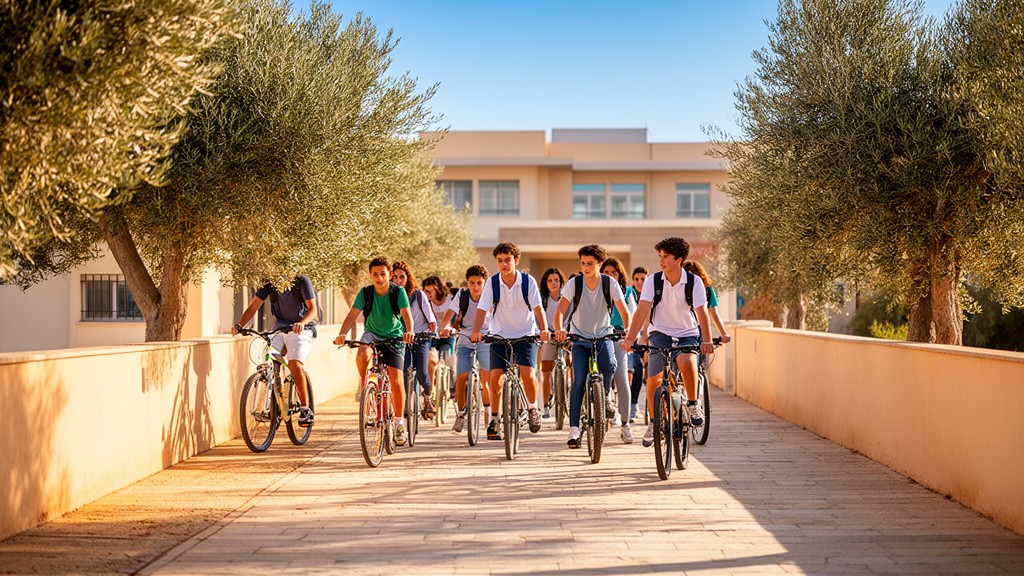
A large-scale epidemiological investigation involving 20,932 children and adolescents across Greece has revealed that 68.8 percent of school-aged students regularly walk or cycle to school, demonstrating a robust association between active commuting and elevated participation in non-organized physical activity. Published in Frontiers in Physiology, the cross-sectional survey evaluated students from public schools situated within the two largest metropolitan regions of the country, Attica and Thessaloniki, between early 2024 and April 2025. Among the diverse demographic, environmental, and behavioral variables analyzed, the physical distance separating a student’s residence from school emerged as the primary determinant governing commuting choices, far exceeding the statistical impact of personal characteristics or built infrastructure. Furthermore, self-reported barriers, particularly household travel convenience and the lack of peer companionship, demonstrated strong independent associations with motorized transport. The extensive dataset offers rigorous empirical insight into urban youth transportation dynamics, clarifying how practical logistical factors and everyday family routines intersect with adolescent movement patterns in southern Europe.
Physical inactivity among adolescents represents an escalating international public health concern, with chronic sedentary behavior during youth directly linked to increased long-term vulnerabilities to cardiovascular diseases, metabolic disturbances, pediatric obesity, and unfavorable mental health trajectories. Health authorities, including the World Health Organization, officially recommend that children and adolescents accumulate a minimum of sixty minutes of moderate-to-vigorous physical activity on a daily basis to safeguard long-term developmental wellness. Despite the widespread dissemination of these guidelines, surveillance studies show that a substantial proportion of young people across the globe fail to reach the designated physical activity benchmarks. Within this public health framework, the daily journey between home and school has gained recognition as a viable, sustainable mechanism for embedding routine exercise into young people’s schedules. Although active travel had been previously documented in Greece, earlier scientific inquiries remained limited to geographically circumscribed cohorts or isolated educational institutions, leaving metropolitan-scale prevalence estimates and multi-factorial correlates largely unexamined.
To address these empirical limitations, the investigators executed a stratified random sampling methodology spanning 369 state-funded educational institutions across Attica and Thessaloniki. The participating population comprised 10,378 male students and 10,554 female students aged between 11 and 18 years, reflecting an evenly balanced gender distribution of 49.6 percent boys and 50.4 percent girls. Stratification ensured comprehensive coverage across key developmental stages, incorporating 5,385 primary school pupils, 8,006 junior high school students, and 7,541 senior high school attendees. Geographically, 246 school facilities were located within the metropolitan territory of Attica, while 123 facilities were situated within Thessaloniki. Research protocols received formal ethical clearance from the Democritus University of Thrace and operational authorization from the Greek Ministry of Education and Religious Affairs. In adherence to the ethical standards delineated in the Declaration of Helsinki, participation was entirely voluntary, anonymous surveys were completed in class settings, and written parental consent was secured for every enrolled minor prior to data acquisition.
The research protocol employed structured assessment instruments to classify travel behavior and quantify activity domains. Commuting patterns were categorized via an adapted questionnaire tracking weekly travel frequencies across active modes, such as walking and cycling, alongside motorized alternatives. Students traveling actively more than five times weekly were defined as active commuters, those utilizing motorized transport more than five times weekly were classified as passive commuters, and those reporting an equal balance formed a mixed commuting cohort. Leisure-time non-organized physical activity was measured through the validated Sallis Weekly Activity Checklist, capturing self-reported physical pursuits maintained for more than fifteen minutes during the preceding seven days. These reported activities were systematically converted into metabolic equivalent task values utilizing the Compendium of Physical Activities, assigning 3 METs to light exertion, 5 METs to moderate exertion, and 9 METs to vigorous activity to establish a cumulative weekly score. In parallel, regular participation in organized club athletics was recorded as an independent binary factor.
Contextual, physical, and environmental metrics were similarly gathered through standardized clinical and geographical methodologies. Physical body height and mass were personally recorded for each student by an investigator utilizing a Seca model 220 physical beam scale, allowing the calculation of body mass index values categorized according to internationally established Cole cut-offs for pediatric populations. Objective residential distances to school were calculated through an electronic mapping platform based on verified addresses, dividing students into six discrete distance bands ranging from under 500 meters to greater than 3000 meters. The geographical analysis indicated that 71.2 percent of all participants lived within 1000 meters of their respective schools, with 39.5 percent situated within 500 meters. Furthermore, perceived obstacles to walking or cycling were evaluated through seventeen distinct psychometric items adapted from established literature, covering topography, built infrastructure, safety from traffic and crime, peer dynamics, baggage burdens, and family travel arrangements, which were aggregated into a composite barrier score.
Multivariable multinomial logistic regression across 20,158 complete cases demonstrated that home-to-school distance wielded the single most powerful association with travel mode, yielding an omnibus likelihood ratio chi-square statistic of 7151.20 with active travel as the reference category. When compared to individuals residing within 500 meters, students living between 501 and 1000 meters away faced an adjusted odds ratio of 2.98 for mixed commuting and 4.43 for passive commuting. As journey lengths widened, the odds of motorized transport escalated drastically: youth living between 1001 and 1500 meters exhibited an odds ratio of 15.95 for passive travel, whereas those residing beyond 3000 meters demonstrated an adjusted odds ratio of 701.17 for passive commuting and 64.21 for mixed commuting. Educational tier also emerged as a significant correlate, with junior high and senior high school students exhibiting substantially reduced odds of mixed and passive commuting compared to primary school pupils. Conversely, sex showed no statistically significant multivariable association with commuting classification.
Direct evaluations of youth movement revealed notable distinctions across the commuting classifications. One-way analysis of variance demonstrated that active commuters achieved significantly greater non-organized physical activity volumes, averaging a weekly metabolic equivalent score of 48.72 ± 41.16 METs, compared to 47.27 ± 40.66 METs among mixed travelers and 42.01 ± 39.66 METs among passive commuters. The statistical difference between active and passive cohorts reached statistical significance, although the corresponding effect size was modest with a Cohen’s d of 0.16. In terms of structured athletic engagement, 58.3 percent of active commuters participated in organized sports, compared with 65.0 percent of mixed travelers and 61.8 percent of passive commuters. Multivariable modeling revealed that regular participation in organized club athletics was associated with slightly higher adjusted odds of mixed commuting (aOR 1.27) and passive commuting (aOR 1.20) relative to active commuting, indicating that structured sports involvement and active school transportation represent distinct behavioral domains rather than mutually dependent physical activity expressions.
When the seventeen perceived barriers were introduced simultaneously into a secondary multivariable model, specific practical impediments proved far more influential than conventional infrastructure deficits. The barrier exhibiting the strongest independent relationship was the perception that being driven was easier because a family member was already traveling in that direction, which increased the adjusted odds of mixed commuting by 47 percent and passive commuting by 57 percent relative to active commuting. Perceiving the school as excessively far also significantly elevated the likelihood of mixed and passive travel. Furthermore, the social perception that peers did not walk or cycle, leaving the individual without traveling companions, independently increased the odds of passive commuting by 16 percent. Conversely, environmental factors frequently highlighted in urban planning discussions, such as the absence of sidewalks or cycle lanes, traffic congestion, poorly lit streets, and hazardous street crossings, failed to maintain statistically significant independent associations with travel mode when fully adjusted for household routines and distance.
The observed active commuting prevalence of 68.8 percent represents a relatively high level of youth active transit when positioned against wider international literature. Comparable investigations have recorded active school commuting rates of approximately 60 percent among Spanish youth and merely one-third among Irish adolescents aged 15 to 17 years, while aligning closely with municipal primary school findings from Thessaloniki showing a 66.5 percent pedestrian commuting rate. However, the study authors emphasized that the elevated non-organized physical activity scores documented among active commuters should not be interpreted as direct mechanical contributions from the commute itself. Because the activity checklist only cataloged continuous activities exceeding fifteen minutes, shorter walking or cycling trips were not captured by the metric. Instead, the higher physical activity observed among active commuters likely reflects a broader orientation toward a physically active lifestyle, where students who choose active travel also engage more frequently in general recreational exercise outside structured environments.
Notwithstanding the substantial cohort size, several methodological limitations must be considered when evaluating these findings. The cross-sectional framework precludes causal inference regarding whether active travel directly fosters broader physical activity habits or whether active tendencies encourage walking to school. Furthermore, commuting patterns and exercise levels relied entirely upon self-reported questionnaires, introducing vulnerability to recall inaccuracies and social desirability biases. Data collection occurred across varying calendar seasons from early 2024 through April 2025 without controlling for localized weather variations, while socioeconomic parameters and parental attitudes remained unmeasured. In addition, urban metropolitan findings from Attica and Thessaloniki cannot be assumed to generalize across rural communities or differing national contexts. The authors conclude that practical interventions aimed at encouraging active school transit must prioritize the definitive constraints imposed by home-to-school distance, focusing safe-route investments, peer-walking networks, and parental commute adjustments primarily upon students residing within viable walking radii.
Subject of Research: Active school commuting and physical activity patterns among Greek children and adolescents
Article Title: Active commuting to school and physical activity participation in children and adolescents: evidence from a large cross-sectional study in Greece
Article References: Karakatsanis, K., Trigonis, I., Grivas, G. V., Tsartsapakis, I., & Zafeiroudi, A. (2026). Active commuting to school and physical activity participation in children and adolescents: evidence from a large cross-sectional study in Greece. Frontiers in Physiology, 17, Article 1848228. https://doi.org/10.3389/fphys.2026.1848228
Image Credits: AI Generated
DOI: 10.3389/fphys.2026.1848228
Keywords: active commuting, adolescent health, physical activity, school travel, built environment, pediatric health, transportation behavior, Greece, Active, commuting, school, physical
Story via the original publisher. Read the original article