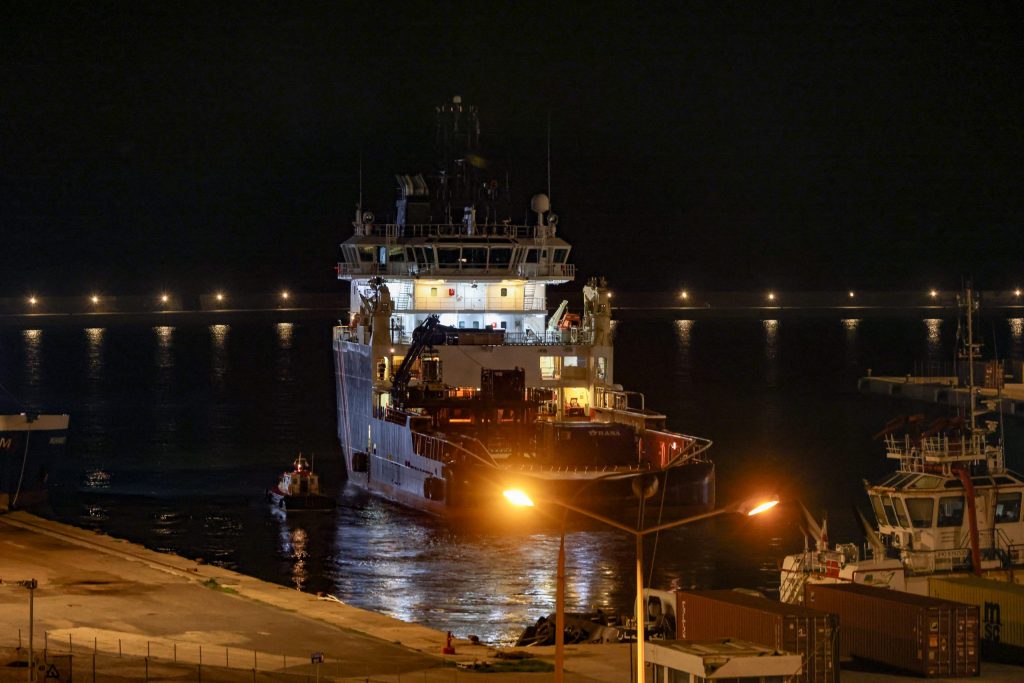
ATHENS – The French research vessel Abeille Marengo sailed from the port of Heraklion at 6:26 p.m. on Tuesday, November 10, to begin seabed surveys for the Greece-Cyprus electricity interconnection. Hours later, Turkey issued a new NAVTEX concerning the vessel’s activities, claiming that the surveys had been coordinated with the competent Turkish authorities and that their consent had been obtained, prompting a response from Athens.
The Abeille Marengo, which had arrived in Crete from Italy and remained at the port of Heraklion pending the start of operations, departed with the assistance of a tugboat after a pilot boarded the vessel. It is initially expected to calibrate its scientific equipment before beginning seabed mapping along the planned cable route, from the Korakia area of Heraklion to Cyprus.
The work includes hydrographic and geotechnical surveys, seabed sampling, penetration tests, and drilling, using specialized equipment such as multibeam echosounders, side-scan sonar, and magnetometers.
The vessel departed under Greek NAVTEX 1411/26, issued by the Heraklion station, which specifies the area and route of the surveys. A corresponding navigational warning has also been issued by the Cypriot authorities.
Turkey’s NAVTEX and its claim of consent
The new Turkish NAVTEX 1127/26, issued later on Tuesday, states that marine scientific research activities by the Abeille Marengo will be conducted along lines coordinated with the competent Turkish authorities and for which their consent has been obtained. It also describes the area as part of Turkey’s continental shelf in the Eastern Mediterranean, citing a letter Ankara sent to the United Nations on March 18, 2020, under reference number A/74/757.
The notice specifies two survey lines and states that activities related to the installation of the underwater cable will take place from November 10, 2026, to March 19, 2027. It also requests that other vessels maintain a distance of two nautical miles.
The wording of the Turkish notice is particularly significant. Ankara goes beyond challenging Greece’s authority to issue the relevant NAVTEX and seeks to portray the surveys as having been coordinated with and approved by Turkish authorities, while reiterating its claims in the area.
The new wording also stands in contrast to Turkey’s earlier counter-NAVTEX 1105/26, issued on November 6, following Greek NAVTEX 1411/26. At that time, Ankara maintained that Turkish authorities had not given their consent for the surveys and demanded that the activities be coordinated with the relevant Turkish authorities. In its latest notice, however, Turkey claims that such consent has been obtained.
Athens’ Strong Reaction: No Turkish Permit Was Requested, Nor Was Any Consent Granted
Athens has rejected the Turkish assertion. Sources at the Greek Foreign Ministry stressed that Greece and Cyprus were the only countries to which an application for authorization to carry out the work had been submitted, and that both had issued the relevant permits.
The same sources noted that the exact route of the vessel became publicly known following the issuance and publication of the Greek NAVTEX. The vessel’s movement took place, and continues to take place, on the basis of the notice issued by the Greek authorities.
The sources described the Turkish NAVTEX as essentially irrelevant, since it was issued after the vessel had already moved and was based on information that had already been made public. They also pointed out that the Turkish notice makes no reference to the issuance of a permit, since no such application had been submitted to the Turkish side. Greece, they added, would take the appropriate action in accordance with international law.
Environment and Energy Minister Stavros Papastavrou made a similar point in Parliament, saying that Turkey was claiming to grant consent without having been asked to do so. He stressed that French cable manufacturer Nexans had applied for work permits only in Greece and Cyprus and that the vessel had sailed on the basis of the Greek NAVTEX.
The project’s history and Turkey’s objections
The latest Turkish move brings renewed attention to Ankara’s objections to surveys for the Greece-Cyprus electricity interconnection. Tensions had also arisen in 2024, when surveys by the Italian vessel Ievoli Relume in the area of Kasos encountered the presence of Turkish warships, resulting in delays and a suspension of operations.
Athens has repeatedly stressed that the project is proceeding in accordance with the established procedures and authorizations issued by the competent authorities. The Greece-Cyprus electricity interconnection, known as the Great Sea Interconnector, is considered a project of strategic importance for the European Union. It aims to end Cyprus’ energy isolation and connect the island to the European electricity grid.
Story via the original publisher. Read the original article