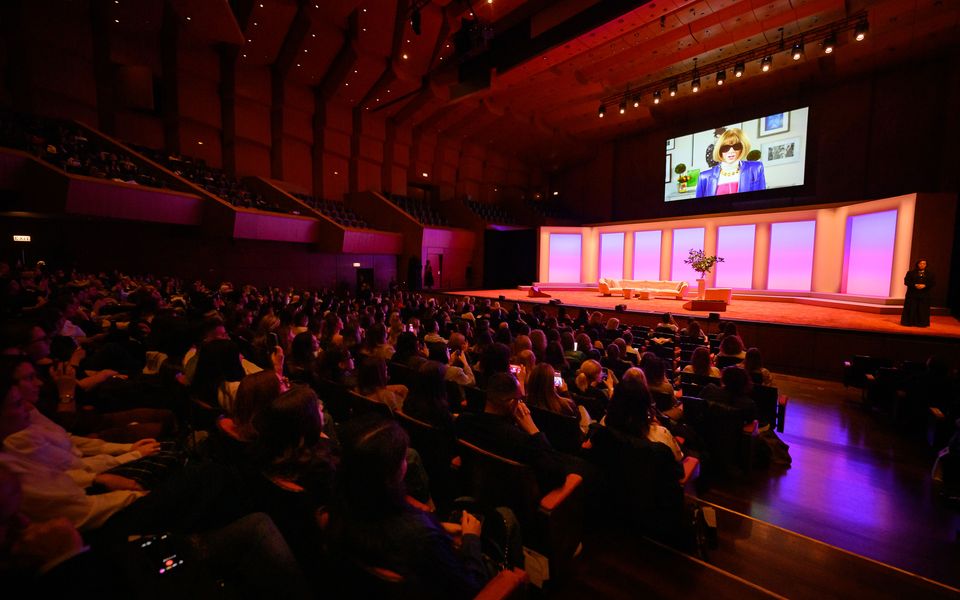
The fourth conference of Vogue Greece and Kathimerini, “Change Makers IV,” placed the most pressing issues regarding the future of the fashion industry center stage, welcoming some of the most influential voices in fashion, beauty, and culture to the Megaron Athens Concert Hall.

How is the value of craftsmanship preserved in the era of artificial intelligence? How potent is the power of image-making in the age of influence? Is beauty a form of performance?
Twelve panels, 30 speakers, fashion and cultural icons, a capacity audience, and leading experts who never stop trusting their instincts, sharing their vision, and staying true to their values explored these questions.
The stylish audience was welcomed by international actress and master of ceremonies Melia Kreiling, who invited Vogue Greece publisher Alexia Koronaiou and Kathimerini’s managing editor of magazines and special editions Giorgos Tsiros to the stage. Together, they addressed the challenges faced by fashion and media in turning shifts into opportunities. Globally, Vogue plays a vital role in this transition by helping its audience comprehend emerging developments, discover fresh ideas, and see the synergies connecting fashion, art, and culture.

This year, Vogue Greece brought these connections to life through “A World In-Between,” an initiative that ran from October 31 to November 5, at the Museum of Cycladic Art.
The floor was given to Dame Anna Wintour, chief content officer of Conde Nast and global editorial director of Vogue, who, via a prerecorded video, underscored fashion’s mission to inspire hope and celebrate creativity in defiance of challenging times. Immediately afterward, Vogue Greece Editor-in-Chief Elis Kiss took the stage, warmly thanking the audience for their energetic presence and officially opening the conference.
Reinventing heritage
The conference’s opening guest was the Greek American creative director of Lacoste, Pelagia Kolotouros, who sat down with Kiss to examine a brand’s capacity to reinvent itself while maintaining timeless appeal. The discussion centred on Lacoste’s iconic crocodile emblem – introduced in 1927 – alongside French elegance and the tennis spirit. “Be curious, do not spend too much time on Instagram because it might kill your brain. Accept ‘no’ as an answer and trust your gut,” she noted, adding: “Naturally, I always consider Lacoste to be a brand for the people.”
Craft, identity, independence
Following the opening, the stage was handed over to artisans and craftsmanship, which safeguard authenticity and celebrate the human touch in the age of artificial intelligence. Yet, how easily can an independent label remain faithful to artisanal methods and flourish?

In the session “Craft, Identity and Independence,” Vogue Runway chief critic Sarah Mower addressed these questions to Maria Lemos, founder of Rainbowwave, and Dimitra Kolotoura, co-founder and CEO of Zeus + Δione. “Zeus + Δione began as a romantic project and evolved into a passion. I truly believe garments possess energy. We are among the few silk artisans left in Europe. When you look at the pattern, it evokes this heritage – something you recall from your grandmother’s home. Let us establish a hub in Greece dedicated to fine, crafted pieces,” said Kolotoura.
The Greek factor
Greek creative identity remained in focus during a panel devoted to the future of local design and concerted initiatives to empower domestic fashion. In “The Greek Factor,” designers themselves led the conversation. Orsalia Parthenis (president of the Hellenic Fashion Designers Association), Yiorgos Eleftheriades (vice president and designer), designer Eleni Kavvada, and Stavros Karelis (head of fashion at the Onassis Foundation) answered questions from Vogue Greece senior editor Kelly Stavropoulou.

“Fashion expertise alone is not enough; it cannot remain self-referential. It must draw from external influences, converse with its era, and engage with fellow creators,” said Parthenis. Karelis added: “We find ourselves in a period of great freedom in fashion. The system is shifting. The right environment and ecosystem are essential to safeguard and support emerging designers properly.”
Tech in fashion
Artificial intelligence – a dominant talking point across the industry – prompted the core question: Who will shape the aesthetic of the future? This theme was examined in “Technology in Fashion and the AI Shift,” featuring Dutch FashionTech designer Anouk Wipprecht and Leanne Elliott Young, CEO & co-founder of Patina, in a discussion moderated by Vogue Greece special correspondent Sarah Bailey. Young noted: “Technology unites cultures and individuals. It allows us to be more human.” Wipprecht added: “I create pieces with both mind and heart.”
Beauty, visibility, longevity
In an era dominated by social platforms, personal image is more visible than ever before. While beauty serves as an instrument of self-expression, perpetual exposure can foster pressure toward perfection. In “The Face of Confidence: Beauty, Self-Expression and Visibility Today,” four industry voices shared their perspectives: Doukissa Nomikou (entrepreneur and L’Oréal Paris ambassador), Harold James (global makeup artist for L’Oréal Paris), and Funmi Fetto (beauty and wellness director of British Vogue), in dialogue with Vogue Greece beauty director Vassiliki Papageorgiou. “Social media can provide a platform to share your aspirations, but it can also induce widespread pressure. The core issue is comparison – which is merely a detail rather than the full picture,” Nomikou observed. Fetto noted: “In makeup, individuality comes to light, and that is truly inspiring.” James remarked: “When you attempt to emulate someone else, you ultimately remain just a copy. When you feel true to yourself, you are far more at ease. Who has the authority to dictate who you are?”

The discourse then turned toward longevity – one of the industry’s defining themes. Living longer is no longer the sole objective; living better represents the new luxury, with the longevity market projected to approach £8 trillion annually by the close of the decade. In “Longevity & Science,” Elisabeth Bouhadana, scientific director at L’Oréal Paris International, conversed with British Vogue’s Fetto.
“Our goal is to improve women’s lives, which makes testing our formulations with women and maintaining an open dialogue paramount. We came to understand that skin is an organ just as vital as the rest of the body, reflecting how we live. If your ambition is to live longer, you naturally want your skin to maintain its youthful vitality for longer.”
Image-making, creative voices
Long before modern content creation platforms, fashion blogs set the digital tone. Susie Lau launched Susie Bubble in March 2006, while Evangelie Smyrniotaki created her digital platform Style Heroine in June 2011. While creator roles continue to evolve, the influence of both figures endures.

In “The Business of Image-Making: the Age of Influence,” Lau and Smyrniotaki joined Vogue Greece editor-at-large Filep Motwary. “Launching a blog without commercial ambitions meant presenting a more personal and perhaps naive perspective on fashion. Yet, if you possess a true passion for garments, why merely write about them instead of wearing them?” said Lau. Smyrniotaki added: “Communicating through words was always difficult for me, which led me to launch my blog in 2011. Fashion became my love language to communicate what I could not express otherwise.”
The “Creative Voices” segment welcomed renowned artist Anne Imhof, recipient of the 2017 Venice Biennale Golden Lion, listed among the Financial Times’ 25 most influential women of 2022, and collaborator with fashion houses such as Burberry and Valentino.

Welcomed by Vogue Greece culture editor Vlasis Kostouros, she said: “My path is intrinsically tied to who I am. How do I bridge that gap? How do I dress in a way that highlights my gender-fluid identity? I feel privileged to present this on stage. There arrives a point where pain converts into strength, akin to a flame. Fashion has always fascinated me because it is functional, yet serves as a costume as well.”
Journalist Suzy Menkes, whose career spans over five decades, took part via a recorded dialogue with the editor-in-chief of Vogue Greece regarding fashion’s trajectory, before surprising the auditorium by attending in person to enthusiastic applause.

Supermodel Helena Christensen then took the stage with Vogue Greece society editor Christina Politi to reflect on the golden era of 1990s modeling, her photographic work, and her role as a UNHCR Goodwill Ambassador. “I was a photographer prior to modeling. I grew up surrounded by cameras. When the chance came to travel to Paris as a model, I viewed it as an opportunity to learn directly from master photographers. That photographic journey led me to the UNHCR a decade ago, which remains the aspect of my photography I hold dearest,” she noted.
Avant-garde vision & modern elegance
Designer Hussein Chalayan discussed his multidisciplinary practice spanning art installations, film, and architectural forms with Vogue Greece fashion features editor Elina Dimitriadi. Reflecting on his 1993 graduation collection – which he buried for six weeks to examine natural decomposition – he shared his perspective: “Social media has painted a picture of fashion that conceals how garments are truly made. Countless people work behind the scenes. What counts most is mastering your technique, cultivating genuine relationships, embracing risks, and drawing inspiration from other worlds to integrate into fashion.”
Supermodel David Gandy sat down with Motwary to discuss his career, including his seminal Capri campaign for Dolce & Gabbana’s Light Blue, which reshaped masculine beauty standards. “I had to contest every barrier. There were rigid assumptions about the limits of male modeling. The more transparently we speak to the public, the deeper their understanding becomes. Tenacity is the only recourse,” he stated. “Masculinity needn’t be convoluted. While I might embody an interpretation of masculinity, defining a man fundamentally comes down to asking what makes a good person. We should all endeavour to be gentlemen.”


The conference concluded with actress Philippine Leroy-Beaulieu in conversation with Kiss on timeless charm and empowerment. “Elegance represents the light of the heart, integrity, and clarity. In an insincere world, preserving internal elegance is demanding. I firmly believe beauty will save the world. It is no privilege; it is rooted deep within us,” she said. “I always felt an innate freedom. Growing up playing with boys, I learned from them. I was always the sort of woman who occupied a space in between, rather than fitting neatly into a single category.”


Story via the original publisher. Read the original article