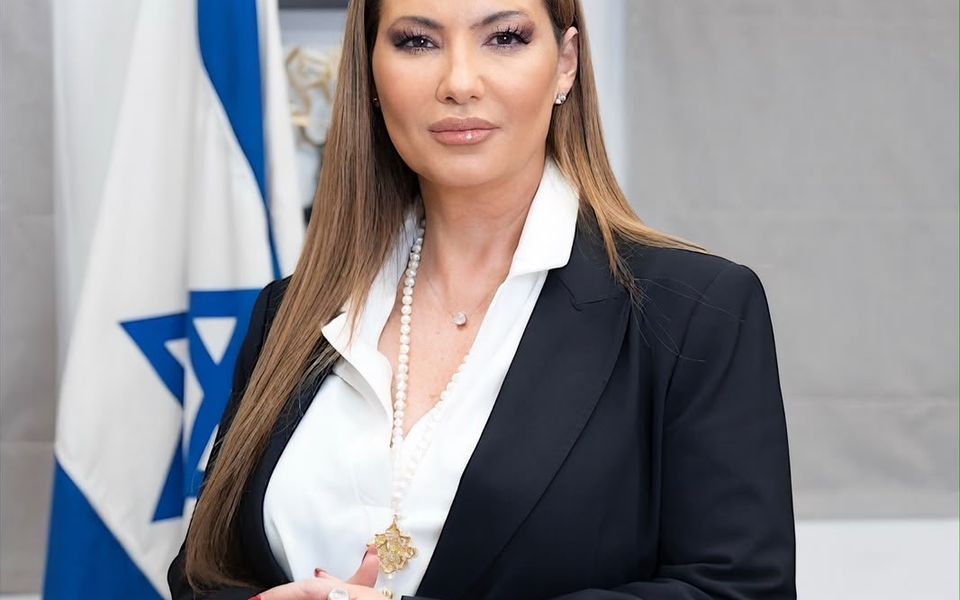
The relationship between Israel and Greece is not affected by Turkey, Israel’s ambassador to Greece, Pninat Yanay, tells Kathimerini in her first interview since assuming her duties.
The ambassador said that Israel will stand by Greece’s side, while also underscoring that Iran’s nuclear ambitions remain a danger to the entire world.
Is there room to further strengthen the Israeli-Greek relationship?
Absolutely. I believe we are entering a new chapter in the relationship between our countries, and I am happy to have the privilege of serving Israel as ambassador at this particular moment. Greece and Israel are two ancient nations with extraordinary histories. But I want us to be just as ambitious about our future. Israel is a global center of innovation and technology — the start-up nation. A small country that has become a powerhouse of ideas and groundbreaking solutions. I believe that combining Israeli innovation, Greek talent, and the rich heritage of our two nations can create extraordinary opportunities. Our cooperation must therefore expand far beyond defense, important as it is. I am talking about medicine, science, research, innovation, technology, agriculture, and education. Cooperation that not only strengthens our countries but also improves the lives of our citizens. And we are already turning this vision into action. During my first months here, I signed a memorandum of understanding with Greek Minister of Health Adonis Georgiadis to promote medical cooperation and bring Israeli medical knowledge and technologies to Greece.
With Evangelos Tournas, Minister of Climate Crisis and Civil Protection, we agreed to promote joint exercises between the firefighting and rescue services of our two countries. With Michalis Chrysochoidis, Minister of Citizen Protection, we agreed to advance cooperation on advanced technologies for policing and public security. In my meeting with Kyriakos Pierrakakis, Minister of National Economy and Finance, we also discussed deeper cooperation in agricultural technologies, as well as investments and economic partnerships.
Today, the world knows Israel as a defense and technology powerhouse. But we should not forget that agriculture was one of the foundations on which our country was built. From making the desert bloom to developing advanced irrigation technologies, Israel has turned agriculture into an engine of innovation. Not everyone knows that modern varieties of cherry tomatoes were developed in Israel, helping turn this small tomato into a successful agricultural product known around the world. Greece and Israel share a similar Mediterranean climate, a deep agricultural tradition, and common challenges involving water, climate, and food production. I see enormous potential in connecting Greece’s great agricultural heritage with Israeli innovation. For me, this is the true meaning of a strategic relationship. Not only cooperation that protects human lives, but also cooperation that saves lives, strengthens food security, creates jobs, and builds a better future. Governments sign agreements, but people build friendships that last for generations. This is the diplomacy I believe in.
Do you believe Greece and Israel could jointly produce defense equipment?
I certainly do. I strongly support the principle of 25% local production under the relevant agreements. True defense cooperation is not simply about purchasing advanced systems. It should create jobs, transfer knowledge, develop local expertise, and build a shared industry. I have friends in Israel’s defense industries who often tell me that even the most advanced Israeli technologies are ultimately built on foundations laid by the great scientists and mathematicians of ancient Greece — Archimedes, Euclid, and Pythagoras. There is something beautiful about that. Thousands of years later, we have an opportunity to reconnect ancient Greek wisdom with modern Israeli innovation. And I have a dream: that one day a Greek child will proudly say, “My grandfather and my father were both engineers in a Greek-Israeli company. I also know the Israeli colleagues who worked with them. Over the years, they became part of the same professional family, and their friendships continued long after their work together.” For me, this is the real meaning of a strategic partnership. Not only agreements between governments, but relationships between people that continue across generations.
Does the Greek-Israeli relationship pose a threat to Turkey, as some in Ankara claim? And are you concerned about a possible conflict between Israel and Turkey?
You should ask Turkey why it considers the relationship between Greece and Israel a threat, as some in Ankara claim. Our friendship with Greece is built for one clear purpose: stability, security, and prosperity. Israel does not seek confrontation. We are a nation that prefers to wake up every morning, create, innovate, and build. But we are also a country that has learned from its history to take every threat very seriously, and we know how to defend ourselves at the highest level. Because Greece is a strategic partner and a true friend of Israel, we will stand by our friend. I believe our entire region needs more cooperation and fewer conflicts.
What is your position regarding the maritime memorandum between Turkey and Libya?
Israel strongly condemns the agreement between Turkey and Libya. Both the Israeli Ministry of Foreign Affairs and the Foreign Minister have expressed a clear position rejecting and condemning this agreement. Our position is based on a clear principle: an agreement between two countries cannot ignore the legitimate rights and interests of a third country, or impose arrangements on a country that is not a party to that agreement. International law cannot be ignored. Let me remind you of something significant. In his speech at the United Nations, Prime Minister Benjamin Netanyahu specifically referred to the importance of Greece to Israel. I cannot remember another speech in which an Israeli prime minister mentioned a particular country by name in this way. That alone says a great deal. It reflects Greece has special place in Israel’s strategic thinking. But the relationship between Israel and Greece is not defined by our relations with other countries. It has its own depth, meaning, and future.
Thousands of Israelis have chosen to live in Athens and other parts of Greece in recent years. How do you view this phenomenon?
First of all, I completely understand them. It is very easy to fall in love with Greece. I experience that myself every day. What is especially interesting is the character of the Israeli community coming here. Many are educated professionals, entrepreneurs, families, and investors. They bring experience, creativity, and economic activity. They discover a culture that feels remarkably familiar: family warmth, the importance of friendship, food, music, and a love of life. Israelis come here not only to buy property, but also to build friendships and contribute to local communities. From my many conversations with Israelis living here, Greece is becoming their second home, but they certainly continue to see Israel as their first home. I believe this human connection is one of the greatest strengths of our relationship.
Could a political change in Israel affect the relationship with Greece?
No. Our friendship is much deeper than any particular government. It enjoys broad support in Israel because it is based on shared interests, shared values, and a very long history. Let me tell you how deep these roots go. As a child in Israel, I learned about Alexander the Great in my schoolbooks. We call him Alexander of Macedon. The story comes from ancient Jewish writings and tells us something profound about the historical connection between our peoples. For me, this is much more than a historical story. It is a story Israeli children learn in school. It symbolizes the depth of the connection between our peoples.
According to the Talmud, one of the sacred texts of Judaism, Alexander of Macedon came to Jerusalem after completing his battles in Egypt and made his way toward the Temple built by King Solomon. Fearing what might happen, Simon the Righteous, the High Priest and the most senior religious figure at the Temple, went out to meet him. While everyone expected a battle to begin, Alexander jumped down from his horse and bowed before the High Priest. At the end of this remarkable encounter, Alexander explained that whenever he achieved victory, he had seen the face of Simon the Righteous. According to Jewish tradition, following this meeting, Simon instructed the people of Israel that every woman who gave birth to a son should name him Alexander.
Think about that. Alexander died at only 32 years old, but thousands of Jewish babies were named after him. His name continued to live for more than two thousand years, through generations of Jewish children who carried it. For me, this is much more than a historical story. It is a story Israeli children learn in school. It symbolizes the depth of the connection between our two civilizations. Our friendship — “Jerusalem and Athens” — did not begin with modern diplomacy, and it will not end with a change of government. The warmth and affection between our peoples carry a historical and human connection that is far greater than any political change.
There have been protests in Athens against Israel following the war in Gaza. Do you consider these expressions of antisemitism, or do you believe Israel could have acted differently?
I respect every person’s right to protest. I recognize that every war brings suffering to civilians. But responsibility for the war and the suffering it has caused must be attributed to Hamas. It is important for me to emphasize that Israel operates in Gaza in accordance with international law and the legal restrictions that apply to its actions. The IDF has legal advisers who accompany military operations, examine the legality of military actions, and advise commanders in their decision-making processes, including before military operations. For years, even before October 7, Israel allowed and supported many measures intended to help the population of Gaza: work permits for tens of thousands of Palestinians, free electricity supplies, medical treatment in Israeli hospitals, including the evacuation of patients by ambulance, humanitarian assistance, and the transfer of significant amounts of money into Gaza. But let us not forget what started this war. On October 7, Hamas murdered, kidnapped, and committed atrocities against innocent people. Women and girls were brutally raped. Entire families were burned in their homes. Babies and children were brutally murdered. Elderly people, women, and children were kidnapped from their homes and held in tunnels in Gaza. All of this happened on the morning of a Jewish holiday, while families and children were in their homes and in their beds. No country can simply ignore such an attack or accept the possibility that it could happen again. Israel has a duty to protect its citizens. At the same time, we must distinguish between legitimate political protest and situations in which protest becomes incitement, hatred of Jews, or intimidation of Israelis. I am glad that Greece has legislation against hate crimes, and I expect it to be fully and consistently enforced. The right to protest is a foundation of democracy, but antisemitism cannot hide behind that right.
How much longer will Israel remain at war?
Israel does not want an endless war. The average Israeli wakes up in the morning wanting to innovate, build, create, succeed economically, and provide a better life for their family. There is a reason Israel is such a successful country. Israelis have a strong motivation to succeed and move forward. War holds back that motivation. Israel does not seek war unless war is forced upon it. But ending a war must mean much more than stopping the fighting. It must create a reality in which another October 7 cannot happen. And here it is important to remember a fact that some people find convenient to ignore: Hamas still refuses to disarm under the agreement with President Trump and continues to declare its intention to harm Israel. Israel wants a future in which Israelis and Palestinians can live in security and dignity, without terrorism determining their lives. This requires responsible leaders in Gaza, chosen by the people of Gaza, genuine security arrangements, and reliable partners committed to calm and order.
Do you believe military hostilities with Iran could resume?
Iran’s nuclear ambitions, its missile capabilities, and its support for terrorist organizations continue to pose a serious security challenge, not only to Israel but to the entire region. Israel will never accept a nuclear-armed Iran, and neither will our partners. Of course, we will always give priority to credible diplomatic solutions backed by effective verification and enforcement mechanisms. But there can be no solution other than the elimination of Iran’s nuclear program, and Israel will always defend its citizens. This solution is necessary not only to protect the people of Israel, but also for the peace of the entire world. I do not intend to discuss possible future military operations. Such decisions are naturally based, among other things, on thorough intelligence assessments that are continuously updated in response to developments and changing realities on the ground.
Could political developments in Washington lead to a reduced American presence in the region?
Despite the midterm elections and their results, which have made things more difficult for President Trump, I do not believe he will turn his back on this region. The Eastern Mediterranean and the Middle East are too important to global security, energy, and international trade. Therefore, I believe that despite political changes in the United States, he will find a way to reach agreements and take the necessary actions. And this is precisely why strong partnerships between countries such as Israel, Greece, and Cyprus are so important.
What is Israel’s position regarding the Great Sea Interconnector (GSI) project?
Israel strongly believes in the strategic importance of this project and in the broader vision of connecting Israel, Cyprus, Greece, and Europe. The world learned an important lesson from the tensions around the Strait of Hormuz: the global economy is like a living body. It needs more than one artery to keep its lifeblood flowing. Energy connections are part of those vital arteries. We need alternative routes, reliable infrastructure, and stronger regional networks. The Great Sea Interconnector represents exactly this kind of long-term strategic thinking. It is about energy security, economic resilience, and connecting our shared future. I believe this project deserves strong support, and Israel attaches great importance to advancing this vision together with Greece and Cyprus.
Story via the original publisher. Read the original article