My yiayia use to reminisce about Greece in the ’40s; describing Athens like a village made of gravel and ‘Sterea Ellada’ – Central Greece – like one big field. Now, it’s my turn to reminisce. Except I am barely 30 and I am yearning for a time less than 10 years ago. I grew up in a Koukaki that looks very different from now, and I’m sure my parents moved into a Koukaki that looked very different from then.
Koukaki is central enough to feel the city’s pulse, without being squeezed too tightly herself. She is a residential neighborhood enlivened by independent shops, trades and crafts, cafés and bars – and the cultural lighthouse that is EMST – the National Museum of Contemporary Art.

Cafeneio spourgiti in Koukaki. Photo: Dione Cavadias
To be cliché, she actually bustles. At night, the voices from Georgiou Olympiou echo throughout the neighborhood. It’s one long pedestrian strip with bushels of people reverberating between orange bar lights. The street feels narrow and messy, demanding closeness, prompting jubilance, and guaranteeing a good time. In the day, the streets hum like plucked strings as the neighbors check off their weekly chores. Veikou has my ‘modistra’ (seamstress), hairdresser, and my parents’ favorite butcher. I get my sudoku, medicine, and baked breads on Matrozou, while Dimitrakopoulou is home to our thrift shops, bookshops, and a very old, very cluttered, cosmetics shop called Avgerinos (that’s where I get my hair clips). We all stumble and stomp around, imprinting our realities on the pavements of Koukaki.

Construction workers on break. Photo: Dione Cavadias
But 10 years ago it was different. My Kifisia friends called Koukaki ‘sketchy’ – now they want to know where to find good parking. Bel Ray was just a car shop, and I could actually see the red and yellow tiles of Georgiou Olympiou. The red ones were lava. The tourists didn’t know about Kalyvas, it was only wrinkly retired men. Our bus stop was moved because EMST was being built. And the corner of Matrozou and Orlof used to have two little shops, stacked together like forgotten shoe boxes, selling fish and old furniture. Above them was this huge, ugly satellite tower that we knighted ‘The Eiffel Tower’. The corner also had a ‘periptero’ (kiosk) with our favorite ice cream. That, as well as the fish and furniture shop, and The Eiffel Tower, are all gone – in their place, a grey apartment building. The bar where I celebrated my 24th birthday is also gone – in its place, a grey apartment building. The MITSI cinema, also gone – in it’s place a grey 41 unit apartment building. Our neoclassical buildings, soon to be gone. In their place…

Georgiou Olympiou Street cafes. Photo: Dione Cavadias
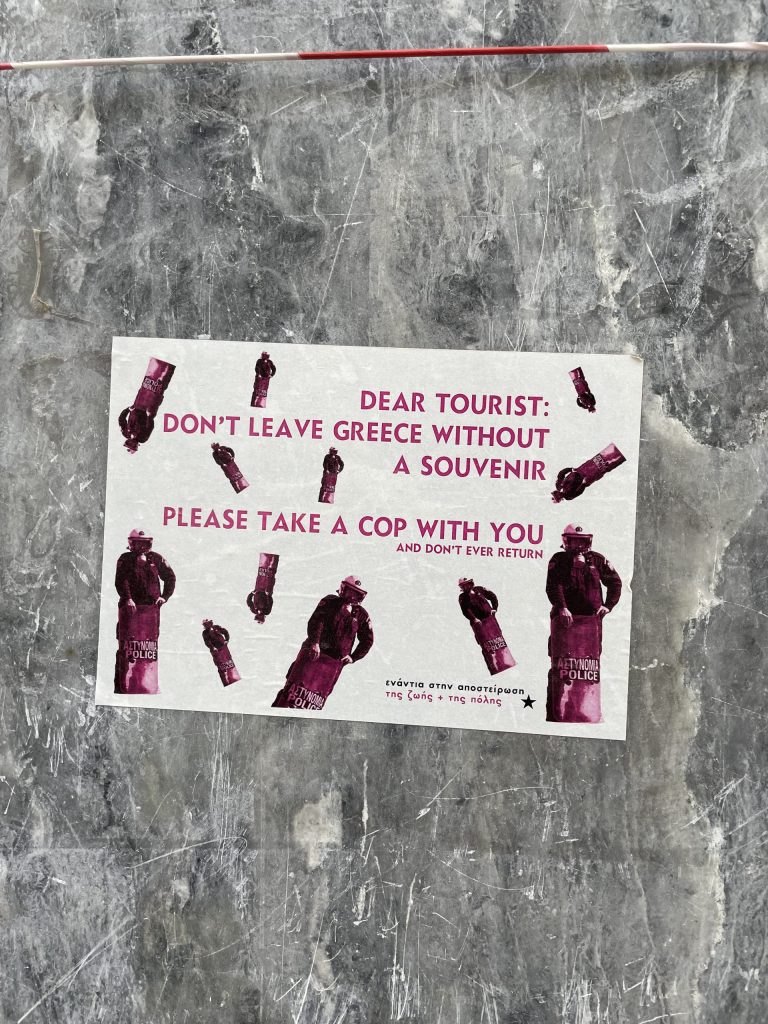
I am not averse to change. In fact, the kind of change I’m looking for would make most Greeks quake. I am averse to gentrification and to a modernization that prioritizes foreign investment over local livelihood. The problem isn’t that new apartment buildings are grey, but that they’re owned by exploitative foreign companies and turned into Airbnbs. I am not a sour 60-year old, but a deflated 28-year-old. I’m watching local identity slip away from me, whilst others label it “development.” All the while, Koukaki has had about 10 power outages in the past three months, our roads are more ‘hole’ than ‘whole’, and we all know what happens to the rain when it rolls down our hill. We build all these buildings, but no one thought of public parking. We renovate all these cafés, but no one considered our local character. Most Koukakiotes hate what’s happening – we’re just too polite to say anything about it. I wish we learnt a little from our friends in Exarcheia.

Koukaki Bar ‘Triky’. Photo: Dione Cavadias
To be in Koukaki, just like many Athenian neighborhoods, is to be aware of all these things. To feel electrified by all the culture, but disenchanted by the politics. To melt away in cafe chairs and curse at the graffiti. To shop from the Greek girl’s new clothing line, as well as yell over the phone with ΔΕΗ. It means celebrating change, but criticizing hollow gestures. To venture into curated exhibitions, but scowl at curated people.

Koukaki Corner. Photo: Dione Cavadias
It means remembering Koukaki, the way she remembers me. She’s my Library of Babel, except she’s stuffed with all my memories. She keeps my childhood in the drawers of her streets, filing them in her shops and pavements, marking them with lampposts. Somewhere between her trees is the smell of my old dog. Zacharitsa remembers what drunk-me forgot. While our neighbors remember us as the family with many daughters.
And although hidden now, from all that bustle, those yellow tiles kept my feet from getting burnt.
We remember so that we can move forward authentically.
That’s all.
Story via the original publisher. Read the original article