Elvis Fatović achieves historic results: an incredible 137 victories and only two defeats in European championships
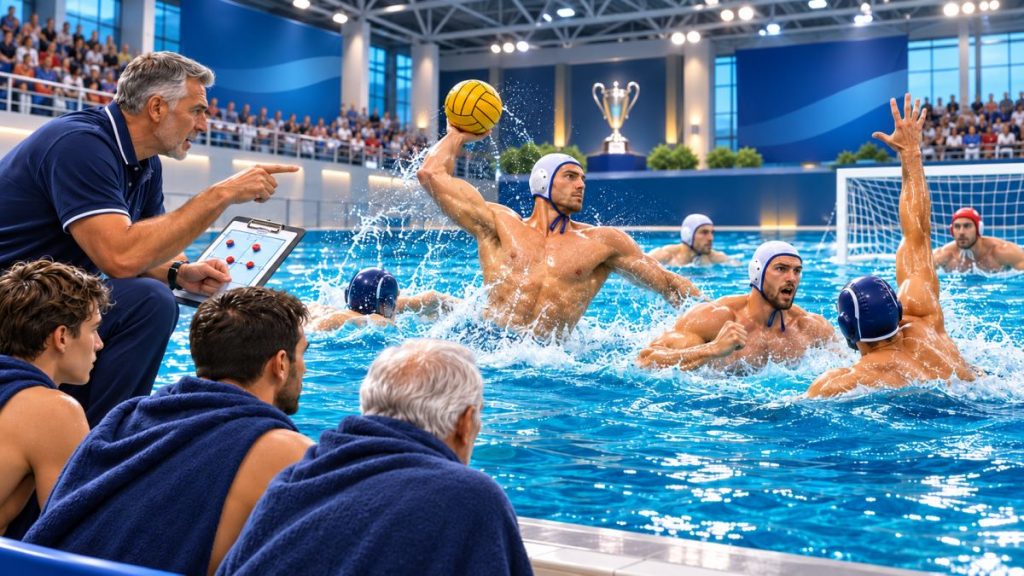
Croatian water polo coach Elvis Fatović continues to achieve results that place him among the most successful coaches in European club water polo. At the helm of Greek club Olympiacos from Piraeus, he has continued the dominance he began in previous years with Spanish side Barceloneta, and his overall record in the national championships of Spain and Greece since returning to Europe in 2021 stands at an impressive 137 victories and just two defeats. The current season further confirms his ability to build a team capable of competing simultaneously on the domestic and international stages. By November 20, Olympiacos had recorded all eight of its league victories and four victories in the Champions League, remaining unbeaten during one of the most demanding periods of the competitive season.
The current appointment is particularly interesting for Fatović because of its family aspect as well. His son Loren Fatović, one of Croatia’s most important national team players, is part of the team he coaches, meaning that father and son are working professionally together at the same club for the first time. Other well-known figures from Croatian water polo are also part of the Greek powerhouse, continuing the long-standing connection between Croatian players and coaches and the club from Piraeus.
From Barceloneta to the Greek powerhouse
His return to European club water polo in 2021 marked the beginning of an exceptionally successful period for the coach from Cavtat. After eight years working as head coach of the Australian national team, Fatović took over Barceloneta and built a team in the Spanish championship that remained among the most consistent competitors for years. During his four seasons in Barcelona, he lost only two league matches. Particularly interesting is the fact that both defeats came against Sabadell during the same season, but his team subsequently responded by winning the playoff final series 2-0.
Such a record is not the result of the players’ individual quality alone, but also of the way Fatović organizes his team. His teams are characterized by disciplined defense, well-organized attacks and the ability to adapt to different opponents. Success in national championships is even more valuable because of the schedule, which often leaves insufficient time for recovery and proper preparation. The coach particularly draws attention to the fact that national team players and the best club players have very little actual rest throughout the year.
The move to Olympiacos represented a new challenge, but it turned out to be an environment that suited his ambitions and working methods. The Greek club already had a strong tradition, significant European results and high expectations, while Fatović was given the opportunity to build a team capable of competing against the strongest European opponents. His first season ended with the club winning the domestic double, and continuing his work brought further confirmation of the team’s stability.
An unbeaten season and success in the Greek championship
In the previous season, Olympiacos, under his leadership, won the championship with a 27-0 record in the league phase and playoffs, in addition to winning the Cup. This result demonstrates just how dominant the team was in domestic competition. What is particularly important to the coach is that this success was not based on just one or two individuals, but on a wide selection of quality players and the ability to maintain a high level of performance throughout the entire season.
The current season has also brought a more serious challenge in the form of Panathinaikos, the biggest domestic rival, which significantly increased its investment in the team during the transfer window. In an interview with Jutarnji list, Fatović pointed out that the match against this rival had been the most important game of the season up to that point. Olympiacos found itself in a difficult situation after Panathinaikos took a 5:1 lead already in the first quarter, but the home team managed to turn the match around and secure victory.
The Croatian Water Polo Federation reported that Olympiacos won that derby 15:12, with Loren Fatović particularly standing out after scoring four goals. His performance was an important part of the home team’s comeback following its poor start. The victory carried additional significance because it demonstrated that Olympiacos could respond even when an opponent dictated the pace and established a considerable lead. Fatović also pointed out that improvements in defense and better decision-making in crucial moments are necessary in matches against the strongest opponents.
By the time the interview was published on November 20, the Greek team had recorded all eight of its league victories. It added another four successful performances in the Champions League, including a victory against German champions Hannover. The latest match was not entirely convincing, as the team had to fight to preserve its lead in the closing stages, but the coach assessed that the objectives set so far had been achieved. Nevertheless, he emphasized that the competitive season had only just begun and that the team’s true character would also be possible to assess based on its reaction after its first defeat.
Croatian players once again an important part of Olympiacos
The connection between Croatian water polo and Olympiacos has lasted for decades. Croatian coaches and players have left a significant mark on the history of the Greek club, and among the coaches who have worked in Piraeus are Ivo Trumbić, Ante Milo Nakić, Dragan Matutinović, Veselin Đuho and Hrvoje Koljanin. Their contributions are part of the broader story of the Croatian water polo school, which has produced outstanding players and coaches for the strongest European clubs throughout different periods.
Among the players who have worn the Olympiacos cap were Josip Pavić, Andro Bušlje and Paolo Obradović, as well as Teo Đogaš, Andrija Komadina, Tihomil Vranješ, Antonio Petković, Maro Joković, Marko Bijač and Ivan Buljubašić. The club won its second European championship title in 2018, with Croatian players playing an important role in its sporting history. The arrival of a new group of Croatian national team players is therefore not an isolated event, but rather a continuation of a long-standing partnership.
Ahead of the current season, Luka Lončar returned to Piraeus from Zagreb’s Mladost, while Loren Fatović arrived from Split’s Jadran. Konstantin Harkov, a Croatian national team player known for his powerful attacking performances, is also among the new signings. This selection of players has allowed the coach to change certain elements of the team’s game compared with the previous season and attempt to further accelerate the attacking transition.
The professional cooperation between father and son attracts particular attention. Loren Fatović is working for the first time at a club where his father is the head coach. In the interview, Elvis explained that their relationship during training sessions and matches is based exclusively on professional responsibilities. In the pool, the coach must be a coach, and the player must carry out his duties regardless of family ties. This approach is also important for maintaining the authority of the coaching staff and ensuring that all team members are treated equally.
A change in playing style and greater emphasis on transition
Fatović has introduced certain changes to the current team compared with last season. Previously, Olympiacos relied heavily on the attacking contributions of players such as Zalanki and center Kakarīs, whom the coach described as one of the most dominant centers in Europe. With the new squad, he wanted to speed up the game and increase the number of situations in which the opposition’s defense is attacked before it has time to organize itself.
According to his assessment, Olympiacos now produces three to four counterattacks per match. This style of play requires good physical conditioning, quick decision-making and the ability to recognize available space effectively. At the same time, the coach believes that the team has room for improvement in defense, particularly in terms of aggression and pressure on opposing attackers.
Fatović compares Greek water polo with the Croatian style of play and particularly highlights the quality of the centers competing in the Greek championship. However, he believes that the traditional strength of play at the center position must be combined with a faster transition from defense to attack. This combination could be particularly important in matches against the best European teams, which have enough quality to punish a slower defensive setup.
These changes are also connected to the new water polo rules, which have accelerated the game and changed the way attacks are organized. Fatović is not a supporter of these rules, but believes that coaches and players must adapt to the new demands. In his opinion, it is no longer sufficient to wait until the attacking time expires and rely on pre-planned plays. Scoring opportunities need to be created earlier, with faster ball circulation and more effective use of space.
The Champions League remains the biggest coaching ambition
Despite his major successes in national championships, one trophy is still missing from Fatović’s coaching career. It is the Champions League, a competition he won twice as a player with Jug, but has yet to win as a coach. The 2001 final at Gruž against Bečej holds a particularly special place in his playing career, as he scored the winning goal in that match.
Olympiacos maintains the highest ambitions in all competitions, but Fatović does not hide the fact that European competition includes several exceptionally strong teams. He identifies Barceloneta, Ferencvaros, Pro Recco and Radnički as some of the strongest, while he sees Marseille, Panathinaikos and his own team among the wider group of serious contenders. He is also particularly impressed by the way Jadran from Herceg Novi plays.
This assessment shows that the coach does not view the European season solely through the results of his own club. In the Champions League, the differences between quality teams are often small, and progression to the final stages can depend on details, player availability and the ability to adapt to different playing styles. That is precisely why winning the European title requires consistency throughout the entire competition, rather than just a few good performances.
One of the biggest problems he faces is an overcrowded calendar. According to him, the best players and national team members have a competitive season lasting at least ten months, and this rhythm has continued even after the pandemic. As an example, he mentioned a situation from the previous season when his team played in Kragujevac on a Wednesday evening, had a match in Zagreb the following Tuesday, and in between those games also had to play against Apollon, a match they barely managed to win.
In such circumstances, the importance of a professional approach becomes even greater. The coach must distribute playing time, assess the players’ physical condition and maintain the quality of training despite frequent travel. These details can be decisive at the end of the season, when the most important matches are played against teams with a similar level of individual quality.
Looking at Croatian water polo and the future
Fatović continues to follow Croatian club competitions and believes that Mladost, Jadran and Jug have the potential to achieve strong results. He sees Mladost as a well-structured team that has maintained its depth and gained additional quality through the arrival of new players. He believes that its results and performances in European competitions show that the team has not lost strength compared with the previous season, but has instead further rejuvenated its squad.
Regarding Jadran, he points out that its focus on developing young players is a good long-term choice, although such an approach can lead to fluctuations in results. In his assessment, Jug also has the quality required to compete at the top, particularly because of its strong outside line. He sees the development of these clubs as an important part of the overall competitiveness of Croatian water polo.
He identifies greater financial resources as one of the key prerequisites for Croatian clubs to return to the very top of European water polo. However, he believes that progress cannot be reduced to budgets alone. The way clubs develop their game, adapt to changes in the rules and create conditions for faster, more modern water polo is also important. He particularly emphasizes the need to create attacking opportunities earlier rather than relying on traditional patterns of play.
Fatović’s professional career outside Croatia has now lasted 16 years. After working with the Australian national team, enjoying a successful period in Spain and taking on his current role in Greece, he feels no need to rush a decision about returning home. He emphasizes that he enjoys working in ambitious environments and that what matters most to him is continuing his coaching career in settings with clear sporting objectives.
His results so far confirm that he belongs to the very select group of successful European water polo coaches. Nevertheless, his personal record in national championships is not the only measure of his ambitions. The greatest challenge remains turning domestic dominance into a European title from the coaching bench, which would complete a career in which he already has major playing and coaching trophies. Olympiacos is currently on an unbeaten run, but the most demanding part of the season is still ahead and will show whether the Croatian coach can achieve this final major objective as well.
Sources:
– Jutarnji list – interview with Elvis Fatović about Olympiacos, his competitive record and coaching ambitions
– Croatian Water Polo Federation – report on Croatian water polo players competing in foreign leagues and Olympiacos’ victory against Panathinaikos
Elvis Fatović
Olympiacos
Loren Fatović
water polo
Champions League
Greek league
Spanish league
Barceloneta
Story via the original publisher. Read the original article